3.3 latest
From the hundekraft 3.3 release.
-
strum.knl 264.1 KB · ↓ 1
- hundekraft
File details
- Format
- hundekraft (kennel) plugin
- SHA-256
b1cbc52a6ee1f72137b755b88243436fd6b77803937c0aa9dcdd9048b573f6d4
A real acoustic guitar that plays along.
Strum is a Martin HD28 acoustic guitar, recorded note by note. Every key plays the right chord for your key and scale, and Strum's right hand plays it in a pattern that follows the tempo. There are 28 patterns, from campfire strumming and funk to Travis picking, bossa nova and flamenco. Keep it in open chords or move up the neck to barre shapes; the neck on screen shows where every finger goes.
To load it: synth then Shift + T1 pick strum
Every key strums straight away. Keep holding and the pattern goes on with the beat. Press another key while you hold one and it strums its chord at once, and the pattern carries on in time; it doesn't start over. Let go of the newest key and the chord goes back to the key you still hold on the next step. Let go of every key and the pattern stops, but the last strum rings out; the envelope's release sets how long. Push blue, green or white for page 2.
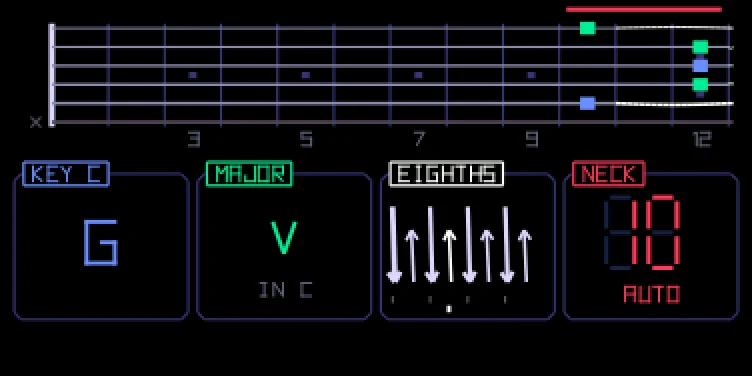
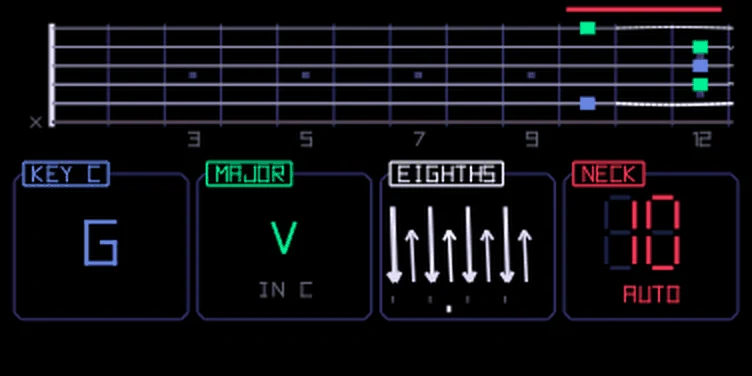
The top of the screen is the guitar's neck, high e on top as in a chord chart. Dots show where the chord is fingered (roots in blue), a green bar is a barre, and X and O at the nut are strings left out or played open. Strings shake while they ring. The red bar above the neck covers the frets your hand would span. Below the neck are four panels, one per encoder. The blue one shows the chord you're playing. The green one shows where that chord sits in the key, such as VIm in C. The white one shows the pattern as down and up strokes, thicker for accents, with a tick under the step that's playing. The red one shows the fret in big digits (00 is an open chord).
| Knob | Control | Turn | Push |
|---|---|---|---|
| blue | Key | The key the chords come from, C to B | Swing: pushes the off-beats late, up to a triplet feel |
| green | Harmony | What each key plays: major, major 7, minor, minor 7, dorian, mixolydian, harmonic minor, sus, power or blues | Human: strokes a little late and uneven, so it stops sounding like a machine |
| white | Pattern | 28 strumming and picking patterns, listed below | Spread: the time between strings in a strum, from a quick 10 ms to a lazy 45 ms |
| orange | Neck | Where on the neck the chords sit: auto, open, or near the 3rd, 5th, 7th, 9th or 12th fret |
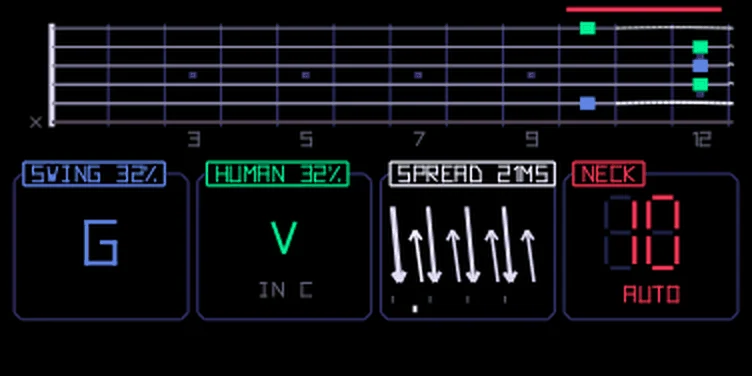
On page 2 a panel's tab shows the page-2 name and value, and the strokes in the white panel move with it: they swing late, wobble with Human and lean further the slower the strum.
Harmony decides the chord. In the scale harmonies each key plays the chord on its step of the scale: in C major, C plays C, D plays Dm, A plays Am. Major 7 and minor 7 play each step's seventh chord (Cmaj7, Dm7, G7, Am7 and so on). Sus plays sus2 or sus4, whichever fits the scale. Keys outside the scale play a major chord, the usual borrowed ones. Power and blues ignore the key: every key plays its own power chord or its own 7th.
Neck on auto picks the shapes by octave. Below middle C you get open chords where there is one, otherwise barre chords. Around middle C it plays barre chords further up the neck, and above that small four-string chords near the top. Open always plays the low shapes. The fret settings put every chord near that fret, whatever octave you play in. Turning Key, Harmony or Neck while you hold a key changes the chord on the next step.
The patterns come in three groups: strums, bass and strum, and picking. Picking patterns play single strings: the thumb takes the bass strings, the fingers the top ones.
| Pattern | What it plays |
|---|---|
| ONCE | One down strum per key, left to ring |
| RAKE | One slow strum, three times wider across the strings |
| QUARTERS | Down strums on the beats, 1 and 3 harder |
| EIGHTHS | Down and up eighths (the default) |
| FOLK | D . D U . U D U |
| POP | Eighths with the backbeat harder and 16th pickups |
| BALLAD | Two bars of half-time strumming |
| MUTED 8THS | Palm-muted down eighths |
| MUTED FOLK | Folk, palm-muted |
| SKANK | Short up strokes on the off-beats |
| FUNK 16THS | Muted 16ths, down and up, ghost notes between the accents |
| RASGUEADO | Flamenco rumba: a four-finger roll on 1 and 3, single strokes between |
| WALTZ | In 3: bass, then two brushes |
| BOOM CHICK | Country two-step: root, chick, the other bass note, chick |
| BASS STRUM | Folk: root, down-up, the other bass note, down-up |
| CARTER | Two bars: a line on the bass strings with a brush after each note |
| BOSSA NOVA | Thumb on root and fifth, the top three strings on the bossa rhythm |
| TRAVIS | Thumb alternating on the beats, fingers between, a pinch on 1 |
| TRAVIS 2 | A steady alternating thumb, with a pinch on the "and" of 2 |
| PIMA | Thumb, index, middle, ring in eighths |
| PIMAMI | In 3: thumb, index, middle, ring, middle, index |
| 6/8 ROLL | In 6/8: the same roll in 16ths, bass on 1 and 4 |
| ARPEGGIO | Bass, then up and back down the top four strings |
| SWEEP 8THS | Eighths up and down every string of the chord |
| SLOW PICK | Two bars of a slow ballad pick |
| INDIE 16TH | 16ths, with the top string between every other note |
| CROSSPICK | Bluegrass crosspicking: three strings in a 3+3+2 roll |
| HARP | 16ths rolling up and down every string, left to ring |
A key pressed while a strum is still sounding cuts it short and strums its own chord, so a quick run of keys gives a string or two of each chord before the last one rings out.
Strum follows the OP-1's tempo and the tape. With the tape stopped it keeps the tempo you set.
There are twelve Strum presets: campfire, folk song, picker, lullaby, parlour waltz, slow ballad, palm mute, bright strum, let ring, bossa, celtic roll and flamenco.
The guitar samples are by Jeff Learman (Martin HD28, from the Discord SFZ GM Bank, released as CC0).
From the hundekraft 3.3 release. Full manual
From the hundekraft 3.3 release.
b1cbc52a6ee1f72137b755b88243436fd6b77803937c0aa9dcdd9048b573f6d4